I had already decided to stop drinking, and Antabuse gave me an extra reason not to bargain with myself. The first week brought a metallic taste and some tiredness, but those effects eased. I still needed counselling because the tablets did not remove the urge to drink.
Antabuse contains disulfiram, an aldehyde dehydrogenase inhibitor used as an alcohol-deterrent treatment for selected adults with alcohol dependence. The dose is decided individually, taking age, other medicines, and health conditions into account, as part of a structured plan to support abstinence.
Overview
Antabuse contains disulfiram, a medicine used as an alcohol-deterrent treatment for selected adults with alcohol dependence. Disulfiram is classified as an aldehyde dehydrogenase inhibitor.
Formulation
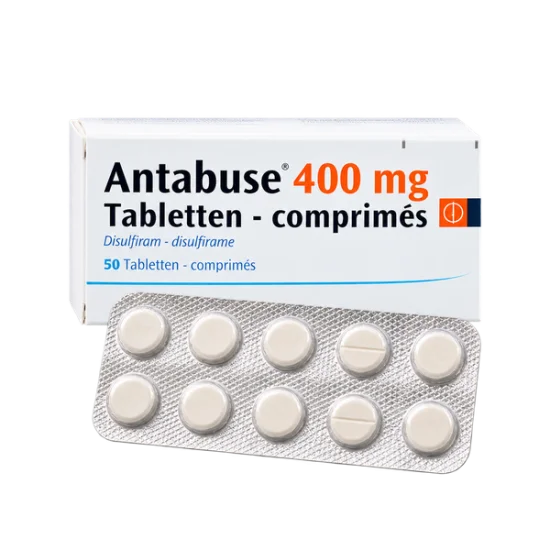
The product is supplied in tablets, with 50 tablets in the described pack. The dose is decided individually, taking age, other medicines, and health conditions into account.
Therapeutic indications
Antabuse contains disulfiram, a medicine used as an alcohol-deterrent treatment for selected adults with alcohol dependence. Disulfiram is intended for people who have chosen abstinence and can follow strict alcohol-avoidance instructions. Clinical use in chronic alcoholic patients requires a structured treatment plan rather than relying on the tablet alone.
The deterrent effect depends on adherence. Antabuse does not prevent intoxication, reverse alcohol dependence, or make drinking safe. It supports a broader programme that can include counselling, relapse-prevention work, family support, and monitoring of liver health. Regular review helps identify adverse effects and changing treatment needs. Continued psychosocial support remains important even when adherence is consistent.
Dosage and administration
Antabuse is taken by mouth as a tablet. The dose is decided individually, taking age, other medicines, and health conditions into account. A prescriber may use a supervised starting period and adjust the dose according to response and tolerability.
Key administration principles include:
- Take the prescribed dose at the prescribed time.
- Swallow the tablet with water unless the prescriber gives different instructions.
- Do not take extra tablets after missing a dose.
- Do not double the next dose to compensate.
- Keep strict alcohol abstinence during treatment.
- Continue alcohol avoidance after stopping until the treating prescriber confirms that the risk period has passed.
- Tell every doctor, dentist, nurse, and emergency clinician that you use disulfiram.
A missed dose should be handled according to the individual treatment plan. Taking two doses together increases exposure without improving the deterrent strategy. If several doses have been missed, the prescriber may need to reassess the restart plan.
The tablet is not an effervescent tablet. It should not be treated as a dissolving preparation or mixed into a drink. Do not crush or split it unless the prescriber or dispensing pharmacist has confirmed that this is appropriate for the specific tablet.
Reasons not to use it
Antabuse is not suitable for everyone.
- You have recently consumed alcohol and have not completed the required alcohol-free interval set by the prescriber.
- You are intoxicated or experiencing alcohol withdrawal that requires urgent clinical management.
- You have had a serious reaction to disulfiram or an excipient in the tablet.
- You have severe liver disease or active hepatitis unless a specialist has specifically determined that treatment is appropriate.
- You have significant coronary artery disease, severe heart failure, or another cardiovascular condition where a sudden blood-pressure drop could be dangerous.
- You have psychosis or severe mental illness that could worsen with treatment.
- You are taking metronidazole or another medicine that creates a clinically significant interaction.
- You use phenytoin, warfarin, isoniazid, benzodiazepines, or medicines processed through hepatic enzymes without a prescriber reviewing the combination.
- You are pregnant or breastfeeding without an individual risk assessment.
Disulfiram can affect the metabolism or effects of several medicines. Warfarin may require closer anticoagulation monitoring. Phenytoin toxicity can occur if phenytoin levels rise. Sedatives may produce stronger or prolonged effects in some people. The full medication list should include prescribed drugs, over-the-counter products, herbal products, and recreational substances.
Liver-function testing may be used before treatment and during follow-up, especially when symptoms or risk factors are present. Medsafe describes disulfiram as a medicine requiring careful attention to alcohol reactions, interactions, and hepatic adverse effects [4].
When this is not for you
It is not appropriate for a person who cannot commit to complete alcohol avoidance or who may be unable to recognise and report a serious reaction.
Antabuse is not for you if
- You have recently consumed alcohol.
- You are intoxicated or experiencing alcohol withdrawal that requires urgent clinical management.
- You have serious liver, heart, or mental-health problems that have not been reviewed by a clinician.
- You take medicines that may interact with disulfiram without a prescriber reviewing the combination.
- You are pregnant or breastfeeding without an individual risk assessment.
Possible side effects
Disulfiram can cause adverse effects even when no alcohol is consumed. Possible effects include tiredness, headache, metallic or garlic-like taste, bad breath, nausea, stomach discomfort, drowsiness, skin rash, and changes in sexual function. Some people develop tingling or burning sensations in the hands or feet, which can indicate peripheral neuropathy.
Liver injury is a serious concern. Warning symptoms include persistent nausea, loss of appetite, unusual tiredness, dark urine, pale stools, yellowing of the skin or eyes, abdominal pain, or widespread itching. These symptoms require prompt medical assessment and may require stopping treatment.
Urgent symptoms after possible alcohol exposure include:
- Severe breathing difficulty
- Fainting or near-fainting
- Chest pain
- Confusion or collapse
- A very fast or irregular heartbeat
- Repeated vomiting
- Seizure-like activity
The disulfiram–ethanol reaction can begin soon after exposure and may remain possible for up to two weeks after the last dose in some patients. The duration varies, so stopping Antabuse does not immediately make alcohol safe. The FDA prescribing information describes cardiovascular, respiratory, neurological, and gastrointestinal complications associated with a severe reaction [1].

How it affects the body
After alcohol enters the body, alcohol dehydrogenase converts ethanol into acetaldehyde. Aldehyde dehydrogenase normally converts acetaldehyde into acetate. Disulfiram interferes with the second step, causing acetaldehyde to accumulate when alcohol is consumed [1].
Blood vessels widen, blood pressure may fall, and unpleasant symptoms can develop. The resulting disulfiram–ethanol reaction discourages further alcohol consumption.
The clinical severity varies with the amount of alcohol, the dose of disulfiram, individual health, and the time since the last tablet [2].
Common mistakes
Common problems with Antabuse treatment include:
- Starting after recent alcohol use.
- Treating the tablet as protection that permits occasional drinking.
- Forgetting ethanol in liquid medicines, cooking products, or mouthwash.
- Stopping the medicine without telling the prescriber.
- Drinking alcohol soon after the last dose.
- Doubling a dose after a missed tablet.
- Failing to mention disulfiram before surgery or emergency treatment.
- Ignoring jaundice, dark urine, persistent nausea, numbness, or severe fatigue.
- Assuming that a low-alcohol drink is harmless.
- Keeping tablets where another household member could take them accidentally.
Comparison
The closest alternatives differ in their main pharmacological target. They are not interchangeable, and the preferred approach depends on liver health, treatment goals, alcohol use, adherence, and the risk of relapse.
| Treatment approach | Main mechanism | Typical clinical role |
|---|---|---|
| Disulfiram | Produces an aversive reaction after alcohol exposure | Supports abstinence when alcohol avoidance and adherence are reliable |
| Acamprosate | Modulates glutamate and GABA-related signalling after alcohol cessation | Helps maintain abstinence after stopping alcohol |
| Naltrexone | Blocks opioid receptors involved in alcohol reward | May reduce the rewarding effects and urge associated with drinking |
Disulfiram is most suitable when the person accepts complete abstinence and understands the alcohol-reaction risk. Acamprosate is used for a different purpose: maintaining abstinence without creating an aversive reaction to alcohol. Naltrexone works through reward pathways and requires attention to opioid use, because opioid analgesics may not work as expected while opioid receptors are blocked. Clinical guidance from NICE and evidence reviews indexed in PubMed describe these medicines as different options within a wider alcohol-dependence treatment plan [3].
What doctors say
Doctors generally view disulfiram as a commitment-based treatment. It can be useful when a person accepts abstinence, understands the alcohol-reaction risk, and has reliable support for taking the medicine as planned. It is less suitable when drinking is unpredictable, supervision is unavailable, or the person is ambivalent about avoiding alcohol.
Clinical practice also shows why early education matters. A patient may stop drinking alcohol but continue using an ethanol-containing cough syrup or mouthwash. Another may discontinue tablets after a difficult week and assume the reaction risk ends immediately. These misunderstandings can lead to preventable emergencies.
A realistic treatment goal is sustained alcohol-free living supported by monitoring and behavioural care. Disulfiram creates a strong deterrent, but it does not treat every biological and psychological factor involved in alcohol dependence.
Common questions
How long does an Antabuse course last, and is long-term use acceptable?
Treatment length varies according to alcohol history, relapse risk, liver health, adherence, and the wider recovery plan. The National Institute for Health and Care Excellence guidance published in 2011 supports planned review rather than an automatic fixed course for every person. Long-term use may be acceptable for selected patients when monitoring continues and the benefits remain greater than the risks.
Which symptoms mean stopping Antabuse and seeking urgent medical help?
Severe breathing difficulty, collapse, chest pain, confusion, repeated vomiting, seizure-like activity, or a very irregular heartbeat after possible alcohol exposure requires urgent medical help. Medsafe’s safety information published in 2024 also supports prompt assessment for jaundice, dark urine, severe abdominal pain, or rapidly worsening weakness. Do not take another dose until an urgent clinician has assessed a serious reaction or suspected liver injury.
What should I do if the expected result does not come?
Antabuse is designed to deter alcohol consumption, not to eliminate cravings or treat withdrawal by itself. If drinking continues, the NHS clinical guidance used in 2026 supports reassessing adherence, alcohol exposure, psychological support, and the suitability of the treatment approach. Do not increase the dose independently; arrange a medication review that considers liver health, interactions, and alternative mechanisms.
How does Antabuse differ from the closest alternative?
Disulfiram creates an aversive reaction when alcohol is consumed, whereas acamprosate acts on excitatory and inhibitory neurotransmission to help maintain abstinence. The World Health Organization’s alcohol-dependence resources published in 2019 describe medication choice as dependent on clinical factors, treatment goals, and patient preference. Naltrexone is another mechanism-based option, but it affects opioid receptors and requires separate precautions involving opioid medicines.
Can Antabuse be used during pregnancy or breastfeeding?
Pregnancy and breastfeeding require an individual assessment because alcohol dependence itself can create serious health risks, while disulfiram has its own safety considerations. The FDA prescribing information published in 2001 recommends that pregnancy exposure be reviewed by the treating clinician, with attention to alternatives and maternal stability. Breastfeeding decisions should account for the infant, the dose, maternal liver health, and the need for relapse-prevention treatment.
Can I drink alcohol while using Antabuse?
Alcohol should be completely avoided during Antabuse treatment because disulfiram blocks aldehyde dehydrogenase and can cause a potentially severe reaction. Medsafe patient-safety information published in 2024 includes attention to hidden alcohol in liquid medicines, mouthwashes, foods, and personal-care products. Alcohol may remain unsafe for a period after the last tablet, so the prescriber should define when the risk period has ended.
What should I discuss with a doctor before starting Antabuse?
Provide a complete list of medicines, supplements, alcohol-containing products, liver problems, heart conditions, mental-health diagnoses, pregnancy plans, and previous reactions to disulfiram. Medsafe guidance published in 2024 supports reviewing interactions and liver-related risks before treatment begins. Tell the clinician whether you can maintain complete alcohol abstinence and whether supervised dosing or additional recovery support is available.
Do you offer anonymous delivery?
Your order will be securely packed and shipped within 24 hours. This is exactly what your package will look like (images of an actual item sent). It has the size and look of a regular private letter (24x11x0.7 cm) and its contents cannot be seen.
Sources
- U.S. Food and Drug Administration (2001). Antabuse (disulfiram) Prescribing Information.
- World Health Organization (2019). The SAFER Technical Package: A World Free from Alcohol-Related Harms.
- National Institute for Health and Care Excellence (2011). Alcohol-use disorders: diagnosis and management of physical complications.
- Medsafe (2024). Disulfiram: Data Sheet and Consumer Medicine Information.
Reviews: Antabuse
The routine helped me stay alcohol-free, especially in the evenings. I made the mistake of using a cough mixture without checking its ingredients and developed flushing and nausea. The reaction passed, but it made me much more careful.
I expected the medicine to reduce cravings, so I was frustrated when the urge was still there. My doctor explained that the purpose was deterrence, not craving control. The treatment became more useful once I added structured support.
I stopped after several days because I felt unusually tired and noticed tingling in my feet. The symptoms needed assessment rather than self-management. My clinician reviewed the treatment and arranged follow-up.