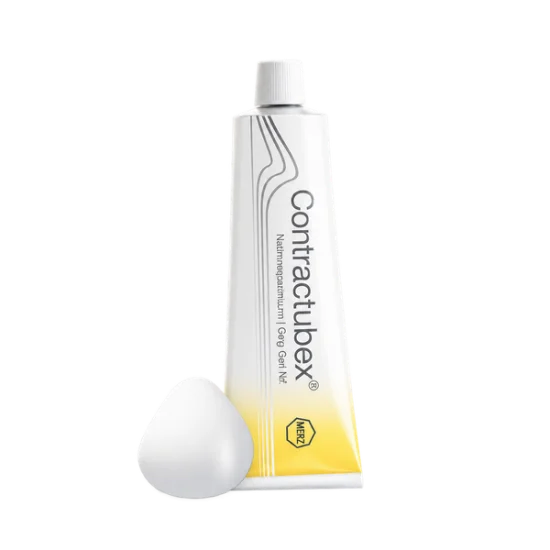
The line felt less tight after I had used the gel regularly for a while. It did not disappear, and the first few applications made the area itch slightly, so I used a thinner layer and gentler massage.
Contractubex
Contractubex is a topical gel for improving the appearance and feel of healed scars after surgery, injury, burns or skin trauma. It may gradually soften firm scar tissue and make redness, uneven texture or tightness less noticeable.
Overview
It may gradually soften firm scar tissue and make redness, uneven texture or tightness less noticeable, but complete scar removal is not a realistic expectation. The aim is a more comfortable, flexible scar. Progress may take weeks or months. Seek review if symptoms worsen.
The gel is intended for closed, healed skin. It is not a treatment for an open wound, active infection, fresh burn or untreated inflammation.
Formulation
Contractubex is a topical gel for scar care on fully healed, closed skin. It is intended to help gradually soften firm scar tissue and make redness, uneven texture or tightness less noticeable. The gel is not intended for open wounds, active infection, fresh burns or untreated inflammation.
Therapeutic indications
Primary Uses of Contractubex
Contractubex may be used as part of scar care for:
- Post-surgical scars after the incision has fully closed
- Scars following minor injuries or other skin traumas
- Healed burn scars
- Post-acne scars where true scar tissue is present
- Firm, uneven or tight scars that remain after healing
Scar care improves appearance rather than treating an underlying infection or reopening wound. Pain, warmth, discharge, increasing swelling or wound separation require medical assessment rather than topical scar treatment.
Expected Scar Improvements
A scar may become softer, flatter, more flexible or less visibly red with continued care. Colour and texture can change at different rates. A scar may feel more comfortable before its appearance changes noticeably.
Older, deep or raised scars often respond slowly. A scar that crosses a joint, restricts movement or becomes increasingly firm needs clinical review.
Dosage and administration
Apply Contractubex as a thin layer to fully healed skin and massage gently over the scar. The amount per application is individual rather than one fixed quantity for every person, so cover the scar lightly without leaving a thick layer.
Daily Application Steps
- Wash and dry the scar area gently.
- Apply a small amount of gel over the closed scar.
- Massage with light, controlled movements.
- Keep the gel away from the eyes, mouth and other mucous membranes.
- Wash hands after application unless the treated scar is on the hands.
- Follow the supplied product directions for application frequency and duration.
Do not scrub the scar before application. Do not use excess gel to try to accelerate improvement.
Treatment Consistency and Results
Scar remodelling is gradual. The skin may feel smoother before the colour or thickness changes. Missed applications can make it harder to judge whether the routine is helping.
A useful progress record is a photograph taken in similar lighting and from the same distance. Comparing a scar immediately after massage with a later photograph can give a misleading impression because temporary redness may occur.
Common Application Mistakes
Common problems include:
- Applying gel before the wound has closed
- Rubbing too vigorously
- Covering the scar with a thick layer
- Applying it over an active infection
- Stopping after a few applications because the scar has not changed
- Continuing despite marked irritation
- Using it close to the eyes or on mucous membranes
Reasons not to use it
Take extra care in the following situations:
- Known allergy to any formulation ingredient
- Very sensitive or eczema-prone skin
- Children or young people
- Pregnancy or breastfeeding
- Scars close to the eye
- Scars over an open, infected or bleeding area
- Concurrent use of dressings, steroid creams or other topical products
Pregnancy and breastfeeding require product-specific advice because the suitability of a topical formulation depends on its ingredients, the treated area and the amount used. Medsafe safety information should guide local use alongside the treating clinician’s advice.
When this is not for you
NOT for you if the scar is open, infected, bleeding, or still healing; seek clinical advice instead. Results vary with the scar’s age, depth, cause, location and response to regular application.
Possible side effects
Topical scar gels can cause local reactions, even when they are designed for use on healed skin. Possible problems include redness, itching, stinging, burning, dryness or irritation at the application site.
Local Skin Reactions
Mild short-lived tingling may occur after application, especially on sensitive or recently healed skin. Stop applying the gel to an area that becomes increasingly sore, swollen, blistered or inflamed.
A widespread rash, facial swelling, lip swelling, wheezing or breathing difficulty requires urgent medical help. These symptoms may indicate a serious allergic reaction.
How it affects the body
Contractubex is applied directly to scar tissue as a topical gel. Its purpose is to support scar remodelling, meaning the gradual reshaping and softening of tissue during the later stages of healing.
Active Components and Their Roles
Scar gels can work through several complementary approaches, such as improving hydration, reducing surface stiffness and supporting gentle massage. These effects may make scar tissue more pliable over time.
The practical result is gradual care of the healed scar surface. A topical gel cannot remove dense scar bands that extend deeply into tissue.
Scar Remodelling and Skin Flexibility
Scar tissue contains collagen arranged differently from normal skin. During remodelling, the tissue may gradually become less firm and more flexible.
Gentle massage can help distribute a thin layer across the scar. Forceful rubbing can irritate the skin and may make discomfort worse.
Evidence for topical scar treatments varies according to the scar type and the formulation used. Silicone-based care has been studied most extensively for some hypertrophic and keloid scars, while other gels may be selected for their texture, massage properties or formulation ingredients [1].

Common mistakes
Common Patient Mistakes
People often apply too much gel, believing a thicker layer will work faster. It usually creates more residue and may increase irritation without improving scar coverage.
Another mistake is treating the colour alone as proof of active scarring. Red or brown marks after acne may be pigmentation rather than a textured scar, and the most suitable care can differ.
Aggressive massage is also counterproductive. Massage should remain comfortable and controlled, not forceful enough to cause bruising or lasting redness.
Comparison
Scar care can involve different formulation categories. Choice depends on scar maturity, location, skin tolerance, adherence and whether the scar is raised or restricting movement.
| Approach | Practical role and limitation |
|---|---|
| Contractubex gel | Topical gel used with gentle massage on healed scars; results vary and dense scar bands may need specialist care |
| Silicone gel or sheets | Frequently used for selected raised scars; adherence, skin comfort and continuous wear can limit use |
| Clinician-led scar treatment | May include injections, dressings, laser treatment, surgery or physiotherapy; suitability depends on the scar and functional effect |
Silicone-based products have a stronger research base for some hypertrophic and keloid scars, though evidence quality and results differ between studies. A Cochrane review found uncertainty across several scar-treatment outcomes, which supports realistic expectations rather than guaranteed improvement [1].
Contractubex and silicone care also differ in daily routine. A gel may be easier to massage into an irregular scar, while sheets may require reliable positioning and longer contact with the skin. Skin irritation, sweating and movement can affect adherence with either approach.
What doctors say
Doctor Perspectives
A clinician would usually assess whether the skin is closed, whether the scar is raised or tight, and whether it affects movement. The cause of the scar matters because a small surgical line and a deep burn scar may need very different care.
A doctor would also check for infection, wound breakdown, keloid behaviour and contact irritation before recommending continued topical treatment. Scar management may be adjusted when the skin remains painful or when function is affected.
Common questions
How should Contractubex be stored at home and while travelling?
Store Contractubex according to the product information supplied for the New Zealand product and keep the tube closed when not in use. Avoid leaving it in excessive heat, direct sunlight or places where children can access it. Medsafe product information (2024) supports careful storage of topical medicines in conditions that protect their quality. While travelling, keep the tube with personal medicines and avoid prolonged exposure to a hot vehicle.
Can Contractubex affect driving, concentration or work with machinery?
Contractubex is applied to the skin, so it is not expected to cause the typical concentration effects associated with medicines that act throughout the brain. Medsafe product information (2024) still supports attention to local discomfort, since painful irritation may distract someone operating machinery. Stop and reassess use if eye exposure, significant burning, swelling or an allergic reaction develops.
How should Contractubex be applied, and how much should be used?
Apply a thin layer to fully healed skin and massage it gently over the scar; the amount is set individually rather than fixed for every person. Wash your hands after application and keep the gel away from the eyes and mucous membranes. EMA guidance on quality and equivalence of topical products from 2024 supports avoiding application to open or damaged skin unless a specific clinical instruction says otherwise. Covering the area should follow the wound-care plan, since an occlusive dressing may not suit every scar.
How long does one application of Contractubex keep working?
One application does not provide a precisely defined duration of effect for every scar. The practical aim is a regular routine directed by the product information, rather than repeatedly applying large amounts when the scar feels tight. WHO Burns guidance from 2023 describes scar change as a continuing process, so visible improvement cannot be guaranteed after one use. Reapply only at the recommended frequency.
What should I do if the expected result does not come?
Do not respond by scrubbing harder, applying a thicker layer or using the gel on an unhealed area. Review whether the scar is fully closed, whether applications have been regular and whether sunlight or irritation may be affecting its appearance. Medsafe product information from 2024 support assessment when a skin problem worsens, remains painful or interferes with function. A raised, rapidly changing or movement-limiting scar may need dermatologist, surgical or physiotherapy input.
How should sun exposure be managed while using Contractubex?
Protect the healing scar from strong sunlight because ultraviolet exposure can make colour differences more noticeable. Covering the area and using suitable sun protection can reduce unnecessary exposure once the skin is closed and able to tolerate the chosen product. WHO Burns guidance from 2023 recognises that healed burn skin remains vulnerable and needs ongoing protection. Do not apply sunscreen over irritated skin until the reaction has settled.
Do you offer anonymous delivery?
Your order will be securely packed and shipped within 24 hours. This is exactly what your package will look like (images of an actual item sent). It has the size and look of a regular private letter (24x11x0.7 cm) and its contents cannot be seen.
Sources
- Cochrane (2013). Silicone gel sheeting for preventing and treating hypertrophic and keloid scars.
Reviews: Contractubex
The scar became softer and easier to massage. I expected a quicker visual change, though, and the redness remained for longer than I hoped. I stopped when the skin became sore and had it checked.
The texture seemed smoother after consistent use, especially along the firmest part. The improvement was gradual rather than dramatic, and I found it easier to judge by taking photographs in the same light.