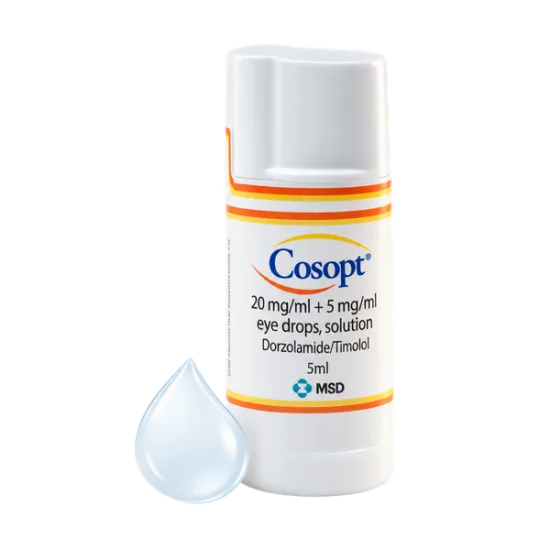
The pressure readings improved at my follow-up appointment. I had a bitter taste at first, and closing my eye with pressure near the nose helped. The drops blurred my vision briefly, so I stopped driving straight after using them.
Cosopt is intended for adults with glaucoma or ocular hypertension when lowering pressure inside the eye is clinically necessary. Its two active ingredients reduce aqueous-humour production and help protect the optic nerve from further pressure-related damage.
Overview
Dorzolamide and timolol, the active ingredients of Cosopt, form a fixed-dose ophthalmic solution for adults with glaucoma or ocular hypertension. The drops reduce fluid production inside the eye, lowering intraocular pressure and helping preserve the optic nerve’s remaining function.
Formulation
Cosopt combines two pressure-lowering medicines from different pharmacological classes. Dorzolamide is a carbonic anhydrase inhibitor, while timolol is a beta-adrenergic blocker.
Dorzolamide Hydrochloride Action
Dorzolamide hydrochloride inhibits carbonic anhydrase in the ciliary processes of the eye. This reduces the formation of bicarbonate ions and decreases the movement of sodium and fluid into the aqueous humour.
Timolol Maleate Action
Timolol maleate blocks beta receptors involved in aqueous-humour production. This lowers fluid formation and contributes to reduced intraocular pressure.
Therapeutic indications
Cosopt is used for open-angle glaucoma and ocular hypertension when lowering pressure inside the eye is clinically necessary. The product controls intraocular pressure; it does not restore optic-nerve tissue or reverse established visual-field loss.
Glaucoma and Ocular Hypertension
Ocular hypertension means pressure inside the eye is higher than the usual range without confirmed optic-nerve damage. Glaucoma involves damage to the optic nerve, or a significant risk of damage, often linked to raised intraocular pressure.
People with glaucoma may have few noticeable symptoms during the early stages. Pressure can remain elevated while vision feels unchanged. Regular ophthalmology appointments measure pressure and assess the optic nerve, visual fields and other signs of progression.
Optic Nerve Protection
Lowering intraocular pressure reduces mechanical and vascular stress on the optic nerve. The aim is to preserve remaining sight and reduce the chance of further damage, rather than sharpen vision that has already been lost.
Dosage and administration
Cosopt is applied topically to the eye as an ophthalmic solution. The regimen for the chosen strength is confirmed with a healthcare professional before starting, because the schedule depends on the treatment plan, response and any other glaucoma drops being used.
- Wash and dry your hands before applying the drop.
- Tilt the head back and gently pull down the lower eyelid.
- Place one prescribed drop into the affected eye without touching the eye or eyelashes with the bottle tip.
- Close the eye gently after application.
- Press the inner corner of the closed eye near the nose for about two minutes.
- Wipe liquid from the cheek with a clean tissue.
- Replace contact lenses according to the product instructions and use them only when the eye is comfortable.
- Leave a suitable interval between Cosopt and other eye drops.
Punctal occlusion means gentle pressure over the tear duct at the inner corner of the eye. It can reduce drainage into the nose and may limit systemic exposure to timolol.
Eye-Drop Administration Technique
Extra drops do not provide extra pressure control. A single drop normally spreads across the eye surface, while overflow runs onto the cheek or into the tear duct.
Brief blurred vision can occur immediately after application. Do not drive, cycle or operate machinery until vision is clear.
Contact lenses should be removed before using the drops when required by the product instructions. Preservatives in ophthalmic solutions can irritate lenses and the eye surface.
Missed Dose and Multiple Eye Medicines
Use the missed dose when remembered unless the next scheduled dose is close. If the next dose is due soon, skip the missed dose and return to the usual schedule. Do not apply two doses together.
Different eye drops should be separated by a suitable interval so one solution does not wash the other from the eye. If one product is an eye ointment, it is generally applied after liquid drops unless the prescriber has specified another order.
Reasons not to use it
Cosopt may not be suitable in people with:
- asthma or a history of asthma attacks;
- severe chronic obstructive airway disease;
- a slow resting heart rate;
- certain heart-conduction disorders or heart block;
- overt or poorly controlled heart failure;
- severe circulation problems affecting the hands or feet;
- a previous serious reaction to dorzolamide, timolol or related ingredients.
The treatment plan needs review if you use medicines that slow the heart rate or lower blood pressure. Relevant groups include some calcium-channel blockers, beta-blockers taken by mouth, anti-arrhythmic medicines, cardiac glycosides and medicines that affect blood pressure.
Dorzolamide belongs to the carbonic anhydrase inhibitor class. Other medicines from the same class may increase the risk of additive effects, including electrolyte or acid–base disturbances, depending on the full regimen.
When this is not for you
Cosopt is not suitable for everyone. It may not be for you if you have asthma, marked bradycardia, or a serious allergy to either active ingredient. Timolol can affect the airways and cardiovascular system even though the product is applied to the eye.
Before treatment starts, disclose respiratory disease, heart disease, fainting episodes, circulation problems, severe allergies and any history of reactions to sulfonamide-related medicines. Tell the prescriber about all glaucoma medicines, heart medicines, diabetes treatments and medicines taken for blood pressure. Diabetes also deserves attention because beta-blockers may mask some warning signs of low blood glucose.
Pregnancy and breastfeeding require an individual risk–benefit decision involving the prescribing clinician. Tell the surgeon and anaesthetist that you use timolol-containing eye drops before an operation.
Possible side effects
Local effects can include burning, stinging, irritation, watery eyes, blurred vision and an altered or bitter taste. These reactions may be temporary, but persistent or worsening discomfort requires clinical review.
Because timolol can enter the circulation, some people may experience a slow heartbeat, low blood pressure, fatigue, dizziness, wheezing or shortness of breath. Dorzolamide may also cause eye irritation and taste disturbance.
Common Local Reactions
Mild stinging after an eye drop is common with many ophthalmic solutions. Blurred vision immediately after application usually improves as the liquid spreads and the tear film clears.
A persistent red eye, severe pain, marked swelling, light sensitivity or deteriorating vision needs prompt assessment. Do not compensate for irritation by applying extra drops.
Taste changes can occur when the solution drains through the tear duct into the throat. Closing the eye gently and using punctal occlusion can reduce this drainage.
Serious Symptoms
Obtain urgent medical help for breathing difficulty, wheezing, fainting, chest pain, severe weakness, very slow heartbeat, facial swelling or sudden visual deterioration. These symptoms may indicate a serious systemic reaction, an allergic response or an acute eye problem.
Stop using the drops and seek urgent clinical advice if a severe allergic reaction develops, unless an emergency clinician gives different instructions. A person with asthma or significant heart disease should treat new breathing or cardiac symptoms as urgent.
How it affects the body
Dorzolamide hydrochloride inhibits carbonic anhydrase in the ciliary processes of the eye. This reduces the formation of bicarbonate ions and decreases the movement of sodium and fluid into the aqueous humour. Timolol maleate blocks beta receptors involved in aqueous-humour production. The two active ingredients reduce aqueous-humour production through complementary pathways.
Common mistakes
Silent Disease and Treatment Adherence
Common mistakes include:
- stopping treatment after a normal pressure reading;
- doubling the next dose after a missed application;
- applying several drops because the first one was not felt;
- touching the bottle tip to the eye;
- failing to leave an interval between different drops;
- wiping the eye immediately and removing the solution;
- missing scheduled pressure checks.
Technique and Follow-Up Errors
A drop placed on the eyelid or cheek may not deliver the intended amount to the eye. If you are unsure whether a drop entered the eye, do not automatically repeat it; follow the prescribed schedule unless a clinician has given different instructions.
Comparison
Treatment alternatives are selected by active ingredient, concentration, preservative system, dosing schedule, tolerance and the target intraocular pressure. A product with a similar name or bottle size is not automatically interchangeable with Cosopt.
| Treatment approach | Main feature | Clinical point |
|---|---|---|
| Fixed dorzolamide–timolol combination | Two mechanisms in one bottle | Useful when both components are appropriate and the target pressure requires combined treatment |
| Separate pressure-lowering drops | Individual medicines in separate bottles | Allows the clinician to adjust or discontinue one component independently |
| Another single-class glaucoma drop | One pressure-lowering mechanism | May be preferred when respiratory, cardiac or ocular tolerability limits combination treatment |
A change may be considered after inadequate pressure control, irritation, allergy, adherence difficulty or a new medical condition. Follow-up pressure measurement is needed after a switch. The decision should not rely on brand familiarity or bottle volume.
What doctors say
In clinical practice, glaucoma treatment is preventive. A person may feel no change while raised pressure continues to affect the optic nerve. Cosopt controls one risk factor, but it does not remove the need for pressure checks, visual-field testing and optic-nerve assessment.
Doctors often see treatment fail because the drop misses the eye, the bottle tip touches the lashes, or the patient stops once vision feels stable. These are technique and expectation problems rather than evidence that dorzolamide or timolol has stopped working.
Common questions
What happens if Cosopt is stopped, and does it need tapering?
Stopping Cosopt can allow intraocular pressure to rise again, even when vision feels unchanged. The FDA's 2023 prescribing information also supports following the prescribed schedule rather than doubling doses. Medsafe product information from 2022 and glaucoma practice guidance support planned treatment changes rather than unsupervised interruption [1]. Tapering is not automatically required for every patient, but the prescribing ophthalmologist should decide whether to stop, reduce or replace it. Seek prompt advice if treatment has been interrupted for more than one scheduled dose.
What should be checked before starting Cosopt?
Before starting, the prescriber should review asthma or chronic airway disease, slow heartbeat, heart block, heart failure, circulation problems, allergies, diabetes and all current medicines. The FDA prescribing information describes these precautions because timolol may enter the circulation after ocular administration [2]. Tell the clinician about other eye drops and any planned surgery. A baseline pressure assessment helps define the treatment target.
Can Cosopt be used during pregnancy or breastfeeding?
Pregnancy and breastfeeding require an individual assessment of glaucoma control and medicine exposure. The European Medicines Agency's 2016 approach to ophthalmic beta-blockers supports weighing maternal benefit against potential fetal or infant effects, with the decision made by the treating clinician [3]. Do not stop prescribed drops suddenly because uncontrolled intraocular pressure can also threaten vision. Report pregnancy, planned pregnancy or breastfeeding before the regimen is changed.
How should Cosopt be stored at home and during travel?
Keep the bottle closed and store it under the conditions stated in the approved New Zealand product information. Medsafe guidance from 2022 supports protecting ophthalmic solutions from excessive heat, freezing, direct sunlight and contamination [4]. During travel, keep the bottle in its original container and avoid leaving it in a hot vehicle. Do not use the solution if the bottle has been damaged or the liquid appears changed.
Is Cosopt suitable for older adults?
Older adults can use Cosopt when the benefits of pressure reduction outweigh the risks for their medical profile. The WHO’s 2023 guidance on integrated eye care emphasises medication review, adherence support and monitoring of co-existing disease in older people [5]. Heart-rate slowing, dizziness, breathing symptoms and interactions with cardiovascular medicines deserve attention. A practical drop technique may be more important than hand strength or speed.
What should be done after a missed dose or application?
Use the missed dose when remembered unless the next scheduled dose is near. In that situation, skip the missed dose and continue normally; do not apply extra drops. If another eye medicine is due, leave a suitable interval between products. Contact the prescribing clinic if missed doses are frequent, because the regimen may need practical adjustment.
Which symptoms mean Cosopt should be stopped and a doctor contacted urgently?
Urgent assessment is needed for wheezing, shortness of breath, fainting, chest pain, severe weakness, marked facial swelling, a very slow heartbeat or sudden visual loss. FDA prescribing information from 2023 supports urgent assessment for serious systemic or ocular symptoms. Severe eye pain, intense redness, light sensitivity or rapidly worsening vision also require urgent evaluation. These symptoms may indicate a serious reaction or an acute eye condition. Do not wait for the next routine pressure appointment when such symptoms occur.
Do you offer anonymous delivery?
Your order will be securely packed and shipped within 24 hours. This is exactly what your package will look like (images of an actual item sent). It has the size and look of a regular private letter (24x11x0.7 cm) and its contents cannot be seen.
How should Cosopt be stored at home and during travel?
Keep the bottle closed and store it under the conditions stated in the approved New Zealand product information. Medsafe guidance from 2022 supports protecting ophthalmic solutions from excessive heat, freezing, direct sunlight and contamination [4]. During travel, keep the bottle in its original container and avoid leaving it in a hot vehicle. Do not use the solution if the bottle has been damaged or the liquid appears changed.
Sources
- Medsafe (2022). Cosopt Eye Drops Data Sheet.
- U.S. Food and Drug Administration (2023). COSOPT (dorzolamide hydrochloride and timolol maleate) Ophthalmic Solution Prescribing Information.
- European Medicines Agency (2016). Guideline on the Clinical Investigation of Medicinal Products in the Treatment of Glaucoma.
- Medsafe (2022). Cosopt Consumer Medicine Information.
- World Health Organization (2023). Package of Eye Care Interventions.
Reviews: Cosopt
The bottle was easier than keeping track of two separate drops. I missed an evening application once and nearly doubled the next one, but the clinic advised me to return to the normal schedule. My eyes felt fine, which made the regular checks seem unnecessary until the clinician explained the optic-nerve risk.
The pressure target was explained clearly, but the drops caused stinging and a red eye that did not settle. I contacted the eye clinic rather than changing the dose. A review was needed before deciding what to use next.
The main improvement was having a clearer routine after being shown how to leave space between drops. I still had a mild bitter taste and occasional short blurred vision, so I used them earlier when I knew I needed to drive.