
Adam, 54
Levin
7 days
Verified
My urinary infection symptoms improved after a few days, and I had no significant side effects.
29 Oct 2026
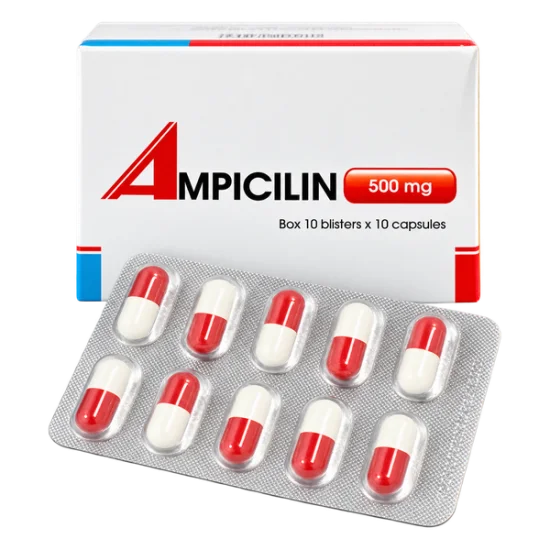
Ampicillin capsules are taken by mouth for susceptible bacterial infections in adults and children. This penicillin-type antibiotic disrupts bacterial cell-wall formation and may treat selected respiratory, urinary, gastrointestinal, skin, bloodstream, and meningococcal infections when prescribed after clinical assessment.
Ampicillin is an aminopenicillin in the beta-lactam antibiotic class. It is bactericidal, which means it kills susceptible bacteria rather than merely slowing their growth. The medicine is used when the suspected or confirmed organism is sensitive to ampicillin and the infection site is suitable for treatment.
The active ingredient is ampicillin, supplied here as capsules. Its antibacterial action comes from interference with bacterial cell-wall construction. Human cells do not build cell walls in the same way, so this process gives beta-lactam antibiotics their selective antibacterial activity.
Ampicillin belongs to the penicillin family. The product is supplied as oral capsules, while other ampicillin formulations may be used in clinical settings when an oral route is unsuitable.
Clinicians may prescribe ampicillin for susceptible infections involving the:
The exact indication depends on the organism, infection site, culture results, local resistance patterns, kidney function, age, and previous allergy history. Medsafe and the World Health Organization both support antibiotic selection based on the likely pathogen and clinical circumstances rather than symptoms alone [1].
A prescribed course is intended for one diagnosed or suspected infection. It does not make leftover capsules suitable for a later illness.
Do not share ampicillin with another person. The same symptoms can arise from different organisms, and some bacteria produce enzymes that inactivate penicillin antibiotics. A culture and susceptibility test can help a clinician decide whether ampicillin remains appropriate.
Ampicillin does not treat viral illnesses such as colds, influenza, or most uncomplicated viral sore throats. Taking it unnecessarily can cause adverse effects and contributes to antimicrobial resistance, which makes future infections harder to treat.
Ampicillin is not suitable for everyone. Extra assessment is needed before treatment when there is a history of serious penicillin or beta-lactam allergy, kidney disease, liver problems, glandular fever, or previous antibiotic-associated colitis.
A previous immediate reaction involving breathing difficulty, throat swelling, fainting, or widespread hives is a serious warning.
Kidney impairment can affect how long ampicillin remains in the body and may require a different interval or dose. Older adults and people who are dehydrated need careful assessment because kidney function can change during an acute illness.
Liver disease, abnormal liver tests, or previous antibiotic-related liver problems should also be disclosed.
Pregnancy is not automatically a reason to avoid ampicillin, but treatment decisions require review of the infection, alternatives, and individual medical history. Ampicillin can pass into breast milk, so breastfeeding plans and infant symptoms should be discussed with the treating clinician.
This medicine is not for you if you have had a serious immediate reaction to penicillin or another beta-lactam and have not received a suitable clinical assessment.
Ampicillin can cause gastrointestinal symptoms, skin reactions, and allergic reactions. The likelihood depends on the person, infection, route, dose, and treatment duration.
Possible effects include:
A mild rash does not always mean the same thing as an immediate penicillin allergy. A spreading rash, blistering, peeling skin, mouth ulcers, facial swelling, or breathing difficulty requires urgent medical attention.
A rash during suspected glandular fever can be extensive and does not by itself establish a lifelong penicillin allergy. The clinical history still needs careful review.
Stop taking the medicine and seek emergency help if there is swelling of the lips, tongue, face, or throat; wheezing; difficulty breathing; faintness; or rapidly developing widespread hives.
Do not wait for these symptoms to settle. Anaphylaxis can progress quickly and requires emergency treatment.
Watery or bloody diarrhoea can occur during treatment or weeks after it ends. It may indicate Clostridioides difficile-associated disease, which requires medical assessment rather than self-treatment with anti-diarrhoeal medicines.
Severe skin reactions are uncommon but urgent. Fever, painful skin, blistering, peeling, or sores affecting the eyes or mouth should be treated as emergency symptoms. The New Zealand Formulary and Medsafe safety information describe serious allergy and antibiotic-associated diarrhoea as reasons for prompt clinical review [3].
Ampicillin binds to bacterial penicillin-binding proteins. These proteins help connect strands of peptidoglycan, the strong mesh that supports a bacterial cell wall. When this cross-linking is blocked, actively growing susceptible bacteria become structurally weak and may rupture.
Ampicillin is bactericidal.
The medicine acts on a bacterial structure that human cells do not possess. This explains why ampicillin can damage susceptible bacteria without targeting human cell walls.
The effect depends on bacterial susceptibility and adequate exposure to the medicine. It is not a reason to increase the dose independently. Taking extra capsules does not overcome resistance and can increase adverse effects.
Some bacteria produce beta-lactamase enzymes that break down beta-lactam antibiotics. Resistance can also arise through changes in bacterial target proteins or other mechanisms.
A clinician may change treatment when laboratory results show resistance, when the infection site requires another antibiotic, or when symptoms worsen despite treatment. The FDA label for oral ampicillin describes the importance of using the medicine only for infections proven or strongly suspected to be caused by susceptible bacteria [2].
Common errors include:
One easily missed detail is that severe diarrhoea may begin after treatment has finished. Another is that a rash with glandular fever can look alarming and should be assessed rather than automatically labelled as a permanent allergy.
Ampicillin, amoxicillin, penicillin G, and flucloxacillin are related beta-lactam antibiotics, but their routes, spectrum, pharmacokinetics, and usual clinical roles differ.
| Antibiotic | Main distinction |
|---|---|
| Ampicillin | Aminopenicillin used for selected susceptible respiratory, urinary, gastrointestinal, bloodstream, and other infections; oral and clinical injectable forms exist |
| Amoxicillin | Related aminopenicillin with different absorption and prescribing patterns; it is not an automatic substitute for ampicillin |
| Penicillin G or flucloxacillin | Different penicillin choices selected according to organism, infection site, route, allergy history, and local resistance |
Amoxicillin and ampicillin share an aminopenicillin relationship, yet they are not interchangeable products. Absorption, dosing schedules, approved indications, and local guidance can differ.
Do not substitute amoxicillin for ampicillin, or the reverse, without prescriber approval. The correct choice depends on the organism and infection site.
Penicillin G is often selected for specific susceptible organisms and clinical situations where its route or pharmacological profile is suitable. Ampicillin has a broader aminopenicillin spectrum, but that does not make it the stronger choice for every infection.
Flucloxacillin is commonly selected when a susceptible staphylococcal infection is suspected, while ampicillin has a different spectrum and clinical role. Laboratory results can change the choice.
Antibiotic stewardship means selecting the narrowest suitable treatment once the organism and susceptibility are known. It also means changing treatment when evidence shows that the first choice is unlikely to work.
In clinical practice, doctors look for a plausible bacterial diagnosis, an appropriate route, allergy history, kidney function, and evidence of response. They do not judge treatment success by symptom relief alone, because fever or pain may improve before the infection has fully resolved.
A clinician may review the diagnosis if symptoms fail to improve, worsen, or change in character. Culture results can lead to a narrower antibiotic, a different antibiotic, or no further antibiotic when a bacterial cause is not supported.
Children can receive ampicillin when a clinician selects it for a susceptible bacterial infection and calculates the dose using age, body weight, kidney function, and the infection being treated. The FDA paediatric labelling principles for ampicillin support individualised dosing rather than conversion from an adult capsule; the relevant prescribing information is dated 2008. A child’s liquid dose should be measured with an oral syringe, not a kitchen teaspoon. Never open an adult capsule and estimate a child’s dose at home.
The duration of antibacterial coverage depends on the prescribed interval, kidney function, infection, and formulation. The product information and clinical plan determine when the next dose is due; taking extra capsules does not extend useful coverage safely. Medsafe’s ampicillin product information (2023) describes dosing intervals as clinical decisions rather than one universal schedule. If several doses have been missed, seek advice rather than restarting with a doubled dose.
Take oral ampicillin according to the dispensing directions, since food may reduce absorption for some oral preparations. Normal gentle activity is guided by how ill you feel, but strenuous exercise is unsuitable when fever, dehydration, dizziness, or significant infection is present. Alcohol does not treat an infection and may worsen nausea or dehydration. The WHO antibiotic stewardship framework (2022) supports following the prescribed schedule and avoiding unnecessary antibiotic use.
Ampicillin capsules should be swallowed as supplied unless the prescriber or pharmacist gives a different instruction. Do not crush or chew them, because the capsule is the intended oral dosage form and altering it can make administration unreliable. People who cannot swallow should have the formulation reviewed rather than opening capsules and measuring the contents. Medsafe product information (2023) is the appropriate reference for formulation-specific administration.
Both are aminopenicillins, but they have different absorption characteristics, schedules, product information, and clinical uses. Amoxicillin is not a direct dose-for-dose replacement for ampicillin. The choice depends on the suspected organism, culture results, infection site, allergy history, kidney function, and local resistance guidance. The EMA’s antibiotic information (2019) supports selecting treatment according to the infection and susceptibility profile rather than assuming that one related penicillin is universally preferable [4].
Contact the treating clinician if symptoms worsen, fail to improve as expected, or new symptoms develop during treatment. Urgent help is needed for breathing difficulty, facial or throat swelling, faintness, blistering skin, severe dehydration, or bloody diarrhoea. Lack of response can reflect resistance, an incorrect diagnosis, an abscess requiring drainage, poor absorption, or a complication. Do not increase the dose or switch to another antibiotic without clinical review. The FDA ampicillin label (2008) and Medsafe guidance (2023) support clinical review before treatment is changed.
Your order will be securely packed and shipped within 24 hours. This is exactly what your package will look like (images of an actual item sent). It has the size and look of a regular private letter (24x11x0.7 cm) and its contents cannot be seen.
My urinary infection symptoms improved after a few days, and I had no significant side effects.
The capsules were straightforward to take, and my doctor advised me to finish the course even after I felt better.
The treatment helped, but I still had stomach upset and needed advice from my pharmacist about taking the doses correctly.
My symptoms settled as expected, and keeping to the prescribed schedule was manageable.